HEALING MINDS, TRANSFORMING NATIONS
At Humura Counseling, our mission is to offer hope, healing, and transformation for individuals, couples, families, and communities across Rwanda. Now in our 3rd year, we are proud to have already served over 600 clients. Mental health is a vital but often overlooked part of overall wellbeing. By analyzing the concerns that clients bring to therapy, we gain a deeper understanding of the challenges faced in Rwanda today. These insights not only guide our clinical work but also help raise awareness among policymakers, educators, and organizations that mental wellbeing is foundational to the nation’s growth.
At Humura Counseling, we proudly work with not only Rwandans but also people from other countries across the world. This article begins by highlighting our data and experience with Rwandan clients, before extending insights to the international community we serve.
The Landscape of Mental Health
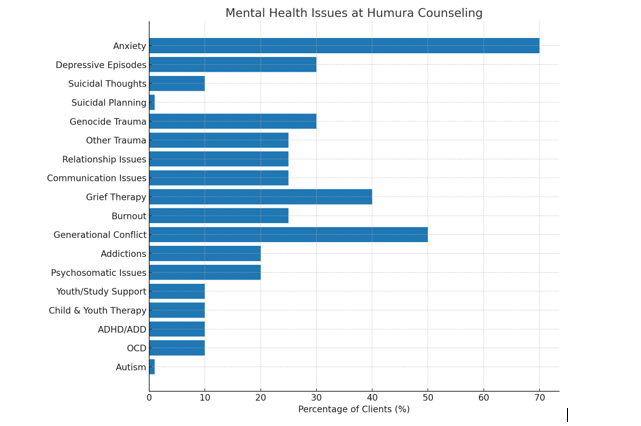
The most widespread concern we encounter is anxiety, affecting nearly 70% of our clients. Anxiety manifests in different forms, ranging from constant worry and sleeplessness to physical symptoms like shortness of breath and restlessness. This indicates that a majority of Rwandans we serve are carrying invisible burdens that impact their daily lives.
Closely linked is depression, affecting 30% of our clients. Depression often presents as persistent sadness, hopelessness, and difficulty functioning at work or in family life. Although these conditions are treatable, stigma and lack of awareness often prevent people from seeking help early.
While less common, suicidal thoughts (10%) and suicidal planning (1%) are issues of grave concern. Even small percentages represent real lives at risk. These cases demand urgent and compassionate intervention, underlining the importance of accessible crisis support systems in Rwanda.
Trauma remains deeply present in Rwandan society. About 30% of clients live with genocide-related trauma, which continues to shape their lives decades later. Another 25% report trauma from life events such as miscarriage, accidents, theft, or abuse. Such trauma can resurface unexpectedly and affect relationships, productivity, and physical health.
We also see clients with conditions such as Obsessive-Compulsive Disorder (OCD), which affects around 10%, and Autism Spectrum Disorder (1%). While smaller in number, these cases require specialized approaches to support daily functioning, social relationships, and emotional wellbeing.
Relationships, Youth, and Family
Relationships are central to wellbeing, yet they are often a source of stress. Roughly 25% of our counseling sessions address marriage, pre-marriage, and relationship concerns, while another 25% focus on communication breakdowns between partners. These figures show that nearly half of our work touches on relational struggles. In many cases, couples are seeking healthier ways to communicate, rebuild trust, or prepare for long-term commitments.
Youth also face unique challenges. Around 10% of clients seek help in making decisions about studies and career paths, reflecting the pressures of navigating Rwanda’s labor market and educational opportunities. Another 10% involve child and youth therapy, where behavioral, social, or academic struggles require guidance. Additionally, ADHD and ADD assessments (10%) highlight the need for better recognition of attention-related disorders in schools, where such conditions are often misunderstood.
Grief is a universal experience, and 40% of our clients come to us seeking support after the loss of a loved one. Through guided therapy, clients learn to process grief, rebuild resilience, and find meaning after loss. Similarly, burnout (25%) is increasingly common, often linked to the pressures of work, financial stress, and the demands of modern life.
Broader Social and Community Issues
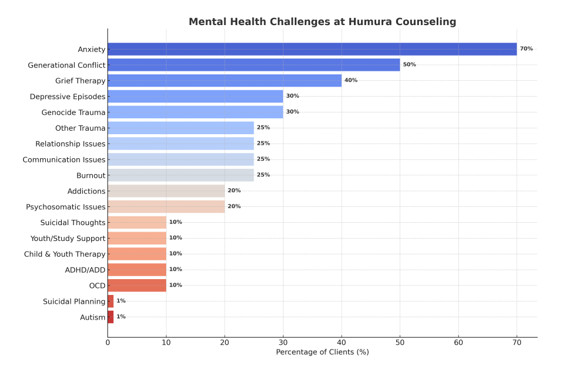
Our practice also highlights issues rooted in Rwanda’s evolving social context. Generational conflict is one of the most striking findings, reported by 50% of clients. Many young people, especially those exposed to global cultures or educated abroad, struggle to reconcile progressive worldviews with the more traditional expectations of their families. This creates tension at home and in communities, underscoring the need for dialogue between generations.
Addictions are another concern. About 20% of clients report struggling with alcohol, cannabis, or other forms of dependency. In many cases, these substances are used as a way to escape from emotional pain. Addressing addiction requires more than just stopping the habit—it involves building healthier coping strategies and addressing underlying issues like trauma or stress.
Finally, psychosomatic issues (20%) are a frequent reminder that mental and physical health are inseparable. Clients present with chronic headaches, stomach pain, chest tightness, or even paralyzing sensations that have no clear medical cause but are rooted in emotional distress. Therapy helps uncover these connections and promotes holistic healing.
Our Approach
At Humura Counseling, we believe that every percentage represents more than a statistic—it represents a person, a family, and a story. To address these diverse challenges, we combine evidence-based approaches with culturally sensitive methods. Our therapies include:
- System Therapy: a holistic approach that clarifies the dynamics and relationships individuals have within their family and social ecosystem. It helps clients understand their position, roles, and interactions, laying the foundation for meaningful therapeutic change
- Eye Movement Desensitization and Reprocessing (EMDR): a trauma-focused therapy that helps individuals reprocess painful memories
- Mindfulness Meditation Therapy: techniques that promote awareness and calm, reducing stress and anxiety
- Family Constellation Therapy: raising awareness of family dynamics and intergenerational patterns.
- Cranio-Sacral Therapy: rebalancing the body to address sleeping problems, psychosomatic pain, and supporting detox from alcohol or drugs.
- Hypnosis by NLP (Neuro Linguistic Programming): reducing trauma intensity through guided hypnosis techniques.
- Self-Hypnosis: empowering individuals with tools for deep relaxation and faster recovery.
- Cognitive-Behavioral Therapy (CBT): structured methods to change harmful thought patterns and behaviors
- Child and Youth Interventions: tailored therapies that consider developmental needs and school challenges.
At Humura Counseling, we emphasize therapy as the foundation of healing. About 95% of our clients are treated without medication, relying on counseling techniques and therapeutic approaches to achieve transformation. However, for severe cases of acute psychosis, bipolar disorder, or schizophrenia, we collaborate closely with psychiatrists to ensure clients receive the right medical treatment alongside therapy. This integrated approach ensures that every client—whether facing mild stress or severe mental health conditions—receives the appropriate level of care.
We also offer specialized programs for leaders and organizations, recognizing that mental wellbeing is key to sustainable success in workplaces and communities.
Services Offered
- Individual & Family Counseling
- Pre‑marriage & Relationship Counseling
- EMDR & Trauma Therapy
- Mindfulness Meditation Therapy
- Family Constellation Therapy
- Cranio‑Sacral Therapy
- Hypnosis Therapy (NLP)
- Self-Hypnosis Training
- Child & Youth Therapy
- ADHD/ADD Assessment
- OCD Counseling & Support
- Autism Spectrum Support
- Grief Therapy
- Burnout & Stress Management
- Addiction Support
Mental health is not a luxury—it is the foundation of personal fulfillment, strong families, and thriving communities. At Humura Counseling, we live by the belief that healing minds transforms nations.
If you, your family, your school, or your organization would like support, please reach out. We are here to walk with you on the journey toward healing and transformation.